You’ve seen the tiny chargers and wondered what is a GaN charger. It’s a wall adapter built on gallium nitride transistors instead of silicon, which lets it run cooler and shrink.
For more on cables, power banks and other add-ons, see our mobile accessories guide.
| Item | Value |
|---|---|
| GaN bandgap compared with silicon | 3.4 eV versus 1.12 eV |
| GaN power density compared with silicon | Generally 5x |
| Size of one 30-watt GaN charger versus a non-GaN charger | Around 40 percent smaller |
| One manufacturer’s estimate of savings on supporting parts | 10 to 20 percent |
These figures come from PCIM’s July 2025 explainer and How-To Geek’s November 2020 update. They can change, so check the source before you rely on them.
What is a GaN charger, in plain terms?
A GaN charger is an AC-DC adapter that uses gallium nitride transistors to turn high-voltage AC from a wall outlet into low-power DC for your devices, according to PCIM. The name is short for gallium nitride, as ChargerLAB explains.
Every charger does the same basic job: it converts high-voltage AC into low-voltage DC. The parts that do the switching in that process are transistors, and a GaN charger swaps some of the silicon ones for gallium nitride ones.
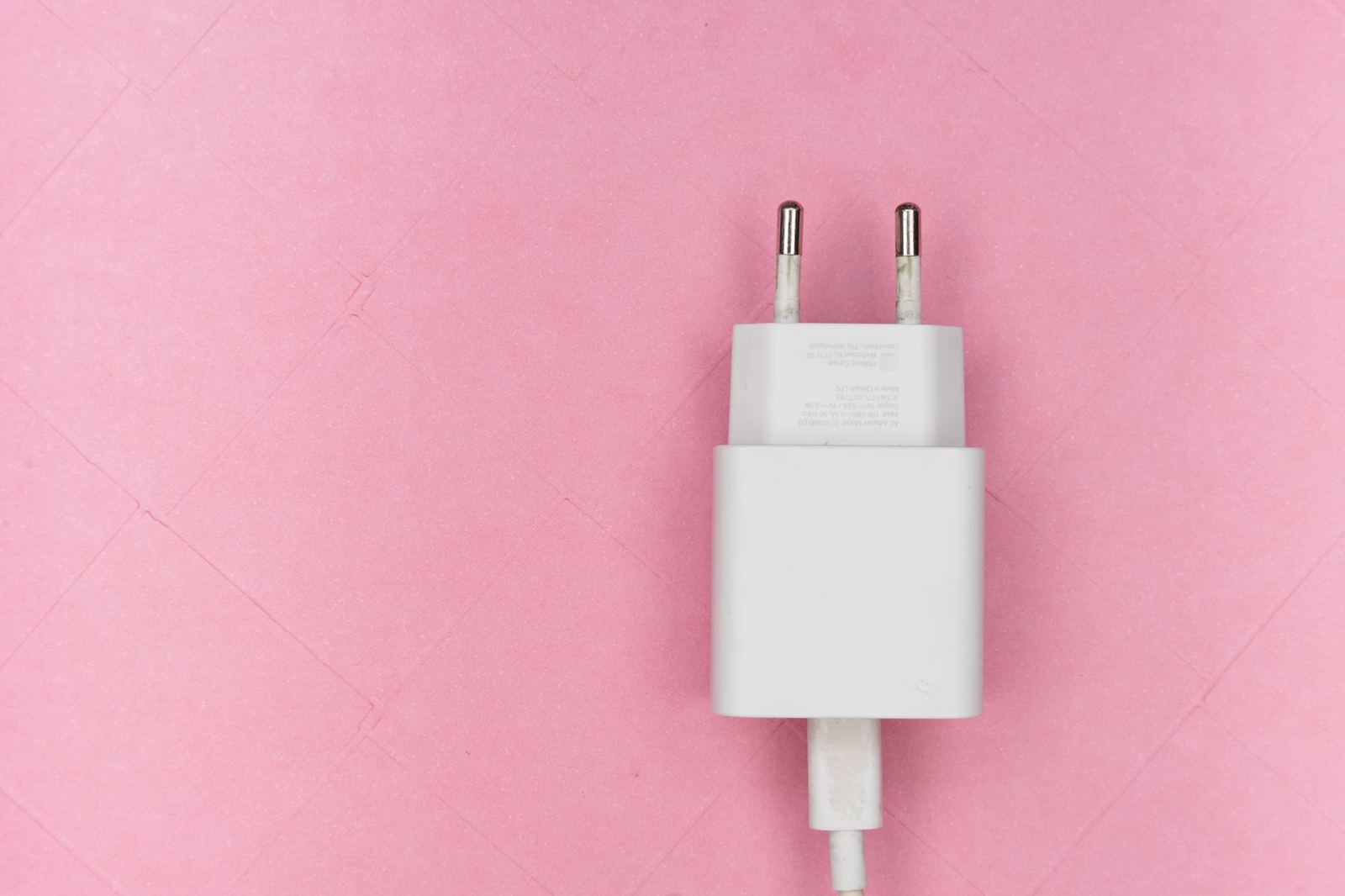
From the outside, it looks like any other adapter. PCIM notes that GaN chargers usually include USB-C power delivery ports, and many have more than one port for charging several devices.
Why are GaN chargers smaller?
In most chargers, the transformer is the largest component, as ChargerLAB points out. For a fixed output power, its size is tied to the frequency of the pulsed current: raise the frequency and the transformer can shrink.
The switching transistor controls that frequency. A GaN switch can run at higher frequencies than a silicon one, with lower losses and better heat dissipation, so the transformer and the whole charger can be smaller than before.
Less wasted energy also means less heat to manage. How-To Geek says GaN chargers need fewer supporting parts such as heatsinks, filters and circuit elements, which also helps the size.
A real example from the same How-To Geek piece is the Anker PowerPort Atom PD1, a 30-watt charger that is around 40 percent smaller than a charger that doesn’t use GaN.
GaN versus silicon: the key differences
The root cause is the bandgap. PCIM gives GaN a wide bandgap energy of 3.4 eV, much higher than silicon at 1.12 eV, and says GaN’s power density is generally 5x that of silicon.
ChargerLAB lists five ways GaN switch transistors outperform silicon ones:
- Higher breakdown voltage
- Faster switching frequency
- Lower on-resistance
- Higher thermal conductivity
- Lower switching losses
PCIM also compares the two chargers side by side:
| Feature | Silicon chargers | GaN chargers |
|---|---|---|
| Power density | Lower | 5x silicon |
| Heat generation | Higher | Lower |
| Device size | Larger | Smaller |
| Cost | Low | High |
That comparison is from PCIM’s July 2025 article, so prices on shelves may differ today.
Where did GaN chargers come from?
GaN is older than most people expect. It only reached wall chargers recently, following this path, according to ChargerLAB and How-To Geek:
- 1928: the compound is first synthesized.
- 1990s: GaN rises to prominence through LEDs, and it later produces the blue light that reads data in Blu-ray players.
- 2014: Navitas, then newly founded, launches the first GaN power IC prototype.
- 2018: Anker is the first to adopt GaN in its chargers.
- Later: Apple launches its first 140W GaN charger.
What do you gain, and what do you give up?
The main gain is a smaller, cooler adapter. PCIM says GaN chargers do not heat as much as silicon ones, and a writer at Android Central reported in June 2021 that a 100-watt Aukey GaN charger could charge two laptops at once and barely got warm to the touch.
The trade-offs are price and expectations. As of How-To Geek’s November 2020 update, GaN semiconductors generally cost more than silicon, though the same piece cites a manufacturer’s estimate of 10 to 20 percent savings on supporting parts. It also warns not to expect a huge change with relatively low-power devices.
A compact charger suits a light travel bag. If you pack other small gear too, our guide on how to choose a phone tripod covers one more item worth carrying.
How to pick a GaN charger
Treat the label on the box as a starting point and match it to your devices. PCIM reminds buyers that any charger can only power a device as much as it can accept.
- Check that your phone or laptop supports USB-C power delivery.
- Match the charger’s wattage to your most demanding device, not your phone.
- Count the ports you need so one adapter can serve several devices.
- Read the manual for compatible devices and ratings.
If you also use wireless charging, our explainer on what is a magsafe charger shows how those pucks fit in, since they still need a power adapter.
Frequently asked questions
Is a GaN charger safe?
Show answer
PCIM says GaN chargers are less likely to be damaged in an overvoltage event because of their higher breakdown voltage. Whichever charger you pick, check the product information and ratings in the manual.
Will a GaN charger charge my phone faster?
Show answer
Not necessarily. A charger can only deliver what your device accepts, and How-To Geek, in its November 2020 update, said not to expect a huge change with relatively low-power devices.
Are GaN chargers more expensive?
Show answer
Usually. PCIM’s July 2025 comparison lists GaN chargers as high cost against low cost for silicon, and How-To Geek said in November 2020 that GaN semiconductors generally cost more.
Can a GaN charger power a laptop?
Show answer
Yes, if the laptop supports USB-C power delivery and the charger offers enough wattage. Android Central’s June 2021 review described a 100-watt GaN charger powering two laptops at once.